

Why Vectarine does not have an Entity Component System
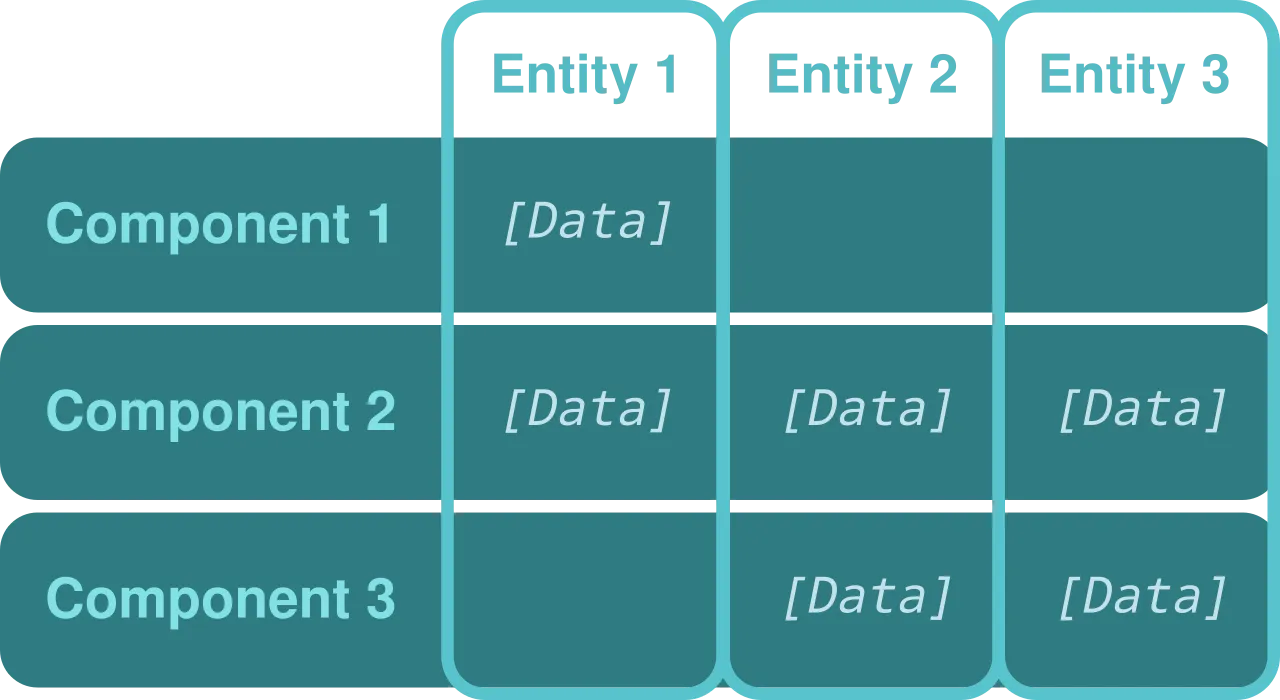
A few game engines, mainly Bevy or Murder, are built around an ECS (Entity Component System) to structure their games. Unity also added an ECS in late 2022 to their engine.
In online spaces, mainly Reddit and YouTube, it feels (at least to me) like ECS are growing in popularity, maybe since 2020.
In this article, I want to describe what ECS are, what their purpose is, and why I didn’t structure Vectarine around an ECS.
What is an entity component system?
Section titled “What is an entity component system?”An ECS is a way to structure your game or game engine. It breaks down games into 3 parts: entities, components and systems.
Entities
Section titled “Entities”Entities are the “things” in your game, the nouns. Players, Monsters, Projectiles, Terrain, etc. In an ECS, they are represented with a single ID. So the entity part of an ECS could be implemented like this:
struct Entities { data: Vec<u32>};If you are using an ECS library, you won’t need to write this struct yourself, the library will handle this.
Components
Section titled “Components”Of course, entities need to store data associated with them. Things like positions, speed, color, sprite, etc. that are more complex than a single number. This is where components come in. You can think of components like the adjectives of your game.
For example, you could have a position component and a color component:
#[derive(Component)]struct Position { x: f32, y: f32,}
#[derive(Component)]struct Color { r: f32, g: f32, b: f32,}And your ECS will allow you to create entities that have a position property.
// Create an entity with just a positioncommands.spawn(Position { x: 0.0, y: 0.0 });
// Create an entity with a position and a colorcommands.spawn((Position { x: 1.0, y: 1.0 }, Color { r: 1.0, g: 0.0, b: 0.0 }));Systems
Section titled “Systems”We have things, with properties. Now we want them to do things. This is where systems come in. Systems are the verbs.
For example, one system could be “gravity” that decreases the y position of all entities with a position:
fn gravity(mut query: Query<&mut Position>) { for mut pos in &mut query { // In a true game, you would have collisions and entities that are not affected by gravity. // I'm simplifying to keep the code short and easy to understand. pos.y -= 1.0; }}The idea of ECS is that you are composing systems together to create your game. Every system runs queries to fetch the entities it needs, and processes them to advance the state of the game.
The ECS’s job is to efficiently implement Query to fetch the entities that match the predicate (you can run more complex queries, like fetching all entities that
have a given set of components).
What is the purpose of an ECS?
Section titled “What is the purpose of an ECS?”ECS has 2 main promises: Performance and Good Code Structure.
Performance:
A well-written ECS will put all of the data of one component into one contiguous array. This data layout is very efficient in the CPU (because of cache locality) and makes fetching and updating lots of components very efficient.
This is similar to what column-oriented databases like Apache Druid or ClickHouse do.
Code organization:
By allowing you to structure your entities with components and systems, it is easy to add new game mechanics. For example, to add a new powerup to your game, you can create entities with the Powerup component, and with a new component specific to that kind of powerup.
This allows for greater flexibility than pure inheritance. This is because when using inheritance, each entity type can only inherit from one other entity type. So if you want to add to your game a power-up that is also an enemy, you cannot inherit from both your power-up and your enemy class.
With an ECS, you don’t have this limitation.
ECS as SQL databases
You can think of an ECS like an in-memory SQL database for your program. Components are tables that are joined using the entity IDs. Systems allow you to efficiently execute the queries and do the “table joins”.
Why doesn’t Vectarine have an ECS?
Section titled “Why doesn’t Vectarine have an ECS?”With all these benefits of ECS, you might wonder why Vectarine doesn’t provide such a system. This is because Vectarine doesn’t want to provide the user with a built-in concept of entities.
Entities can be tricky and not all games want them. So we prefer to provide lower-level functions for drawing, physics, etc. and let users assemble these concepts together to create their game.
Because we give users full control, they can build systems that are purpose-built for their specific games that are more efficient than what an ECS can provide.
Limitations when using complex queries
Section titled “Limitations when using complex queries”This is because an ECS is only as good as its query system. If you want to fetch all entities that are monsters, it’s super simple, it’s just a tag.
But when you want to fetch all triplets of entities that are within 10 units of one another where one is a monster, another is a player and the third is an explosive (maybe your monster AI has monsters shoot at TNT to hurt the player), your ECS might struggle to do that efficiently, even if you use a general-purpose space partitioning system.
But if you build your own entity storage, you know what your game needs, so you can optimize for it specifically.
For example, you can write a purpose-built space partitioning system to quickly answer queries about finding close entities that can efficiently create, move and delete large amounts of entities, or maybe you can use knowledge about how TNT spawns in your game to optimize your lookup. This is something that a general-purpose querying system cannot do.
ECS make engineering more fun than game design
Section titled “ECS make engineering more fun than game design”There’s an old joke in the Rust community: for every game made in Rust, there are ten game engines. I’m writing a game engine myself, so I’m in no position to laugh too hard.
But I think ECS makes this worse. Designing systems and queries is satisfying in the same way building an engine is: it feels like progress, and there’s always something to optimize. Making a game fun is a different, messier job, and an architecture that rewards engineering can quietly pull you away from it.
This matches what I see online: a lot of praise for Bevy’s architecture, and far fewer shipped games.At the time of writing, Bevy is about 5x more popular than Löve2D on GitHub, but has about 8.5x fewer games on itch.io (Bevy games, Löve2D games). This doesn’t prove anything: Bevy is younger, has no editor, and Rust is harder to learn than Lua.
Extra indirection
Section titled “Extra indirection”Personally, I find this code easier to read than a set of systems:
local strongestPlayer = nilfor player in players do if isStronger(player, strongestPlayer) then strongestPlayer = player end -- Note that methods does not mean OOP. The ':' syntax is about convenient for autocompletion, not class hierarchies -- The vectarine guide about understanding hot-reloading explains how you can turn functions into methods simply. player:handleMovement()end
for enemy in enemies do local nearbyPlayers = findClosePlayers(enemy.position, enemy.sightRange) if #nearbyPlayers == 0 then enemy:wander() else if contains(nearbyPlayers, strongestPlayer) then enemy:flee() else enemy:chase() end endendIn this example, I understand read the complexity straight from the code: one loop over the players, one loop over the enemies,
and findClosePlayers, which I wrote myself and know uses a spatial index.Assuming players are spread evenly, on average, that’s about
.
Nothing runs that I can’t see.
With systems, the same logic is split between queries, the ECS’s storage and the scheduler, and estimating its cost means knowing how the ECS works inside, which
can be tough when you’re not experienced with it.
What does Vectarine do instead?
Section titled “What does Vectarine do instead?”Vectarine essentially lets you do whatever. I’m encouraging you to use functions that take tables and produce other tables, and generally follow functional patterns. I think this is better, especially for beginners who might not be experienced in programming, as they have less to learn and worry about.
You have data inside tables, and functions that act on the data, because that’s all you need, especially for game prototypes where you might have fewer than a few thousand “entities”.
If you want performance, you can use a fastlist which packs data together in memory and allows for very fast mutations.
This gives you a lot of flexibility in your code and allows you to follow the structure that is best suited for your game. Because Luau is dynamic, you can add the fields you want to your tables.
You can build your own ECS on top of Vectarine if you have a simulation-like game, or follow an inheritance-based approach using Luau’s metatables. You’re free to choose the paradigm you know best!
Vectarine optimizes for getting a fun game running quickly, and the structure should serve the game and the fun, not the other way around.